Why Are Olympic Athletes Still Broke?
The Olympics generate billions. Athletes see almost none of it. Here's how Executives make 109x more than athletes.
2/25/20264 min read
Every four years, the best athletes from dozens of different sports gather to compete in front of the entire world at the Olympics. The athletes who are lucky enough to compete at the competition have trained their entire lives to represent their countries, and only the very best of these elite athletes can ever win an Olympic medal. Billions of people tune in. Billions of dollars flow in.
So where does all that money actually go?
Because here’s what the scoreboard doesn’t show you:
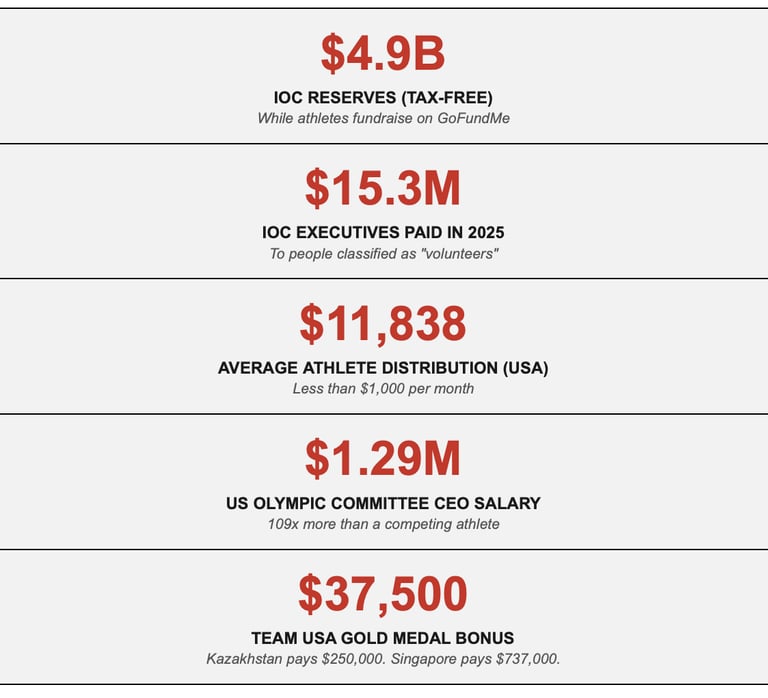
The Olympics sits on $4.9 billion in reserves — with another $18.4 billion in future earnings already secured through 2036
The Olympic Committee is classified as a non-profit and pays zero taxes on any of it
And yet... 60% of Olympic athletes are not financially stable
The greatest sports organization on earth is flush with cash. So why are so many athletes struggling financially?
Here’s what actually happens…
THE PYRAMID: HOW THE OLYMPICS ACTUALLY WORK
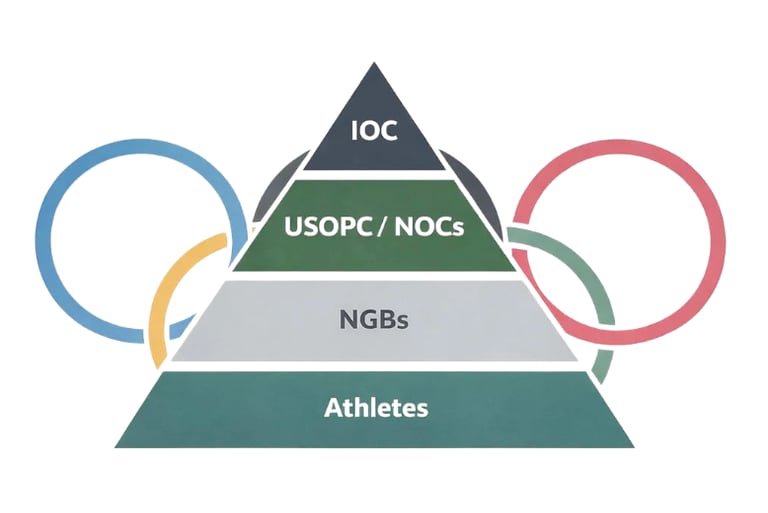
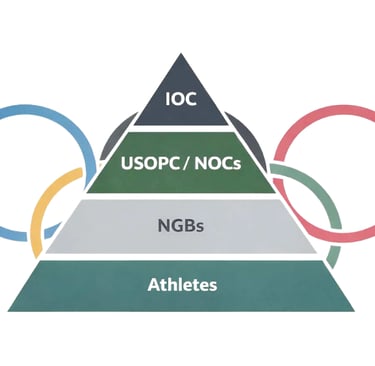
Think of the Olympics as a pyramid. At the top sits the International Olympic Committee (IOC). Below them are the National Olympic Committees, one per country. Below those are the National Governing Bodies (NGBs) for each sport. And at the very bottom, holding up the entire structure on their backs, are the athletes.
Every layer of this pyramid has executives pulling six- and seven-figure salaries. And at every layer, money vanishes before it reaches the athletes.
From 2021 to 2024, the International Olympic Committee generated $7.7 billion in revenue.
NBC alone paid them $7.75 billion for broadcast rights through 2032.
They claim to redistribute 90% of that revenue — and they list athletes first in that claim
But, the Olympic Committee does not directly pay any income to athletes. Nothing.
Instead, they distribute funds to the next layer down — National Olympic Committees — with athletes tacked on as an afterthought in the accounting. The money travels through the pyramid and by the time it reaches athletes, most of it is already gone
The Stats Don’t Lie
HOW THEY TRICK YOU WITH NUMBERS
Here’s where it gets deliberately confusing.
In 2024, the US Olympic and Paralympic Committee (USOPC) had $515 million in revenue. They claim that $233 million, or 61% of all spending, went to “athlete excellence.” That sounds incredible. But let’s look at what actually counts as “athlete excellence”.
$31.8 million went to USOPC employee salaries.
Millions more covered their travel, software subscriptions, and office supplies.
The USOPC has 642 employees, and virtually every one of them is categorized somewhere inside those “athlete expenses.”
It’s the same trick at every layer. They bundle athlete support with other costs, making it look like they pay the athletes millions, But, by the time the money reaches the 1,436 athletes who received distributions, just $17 million was left.
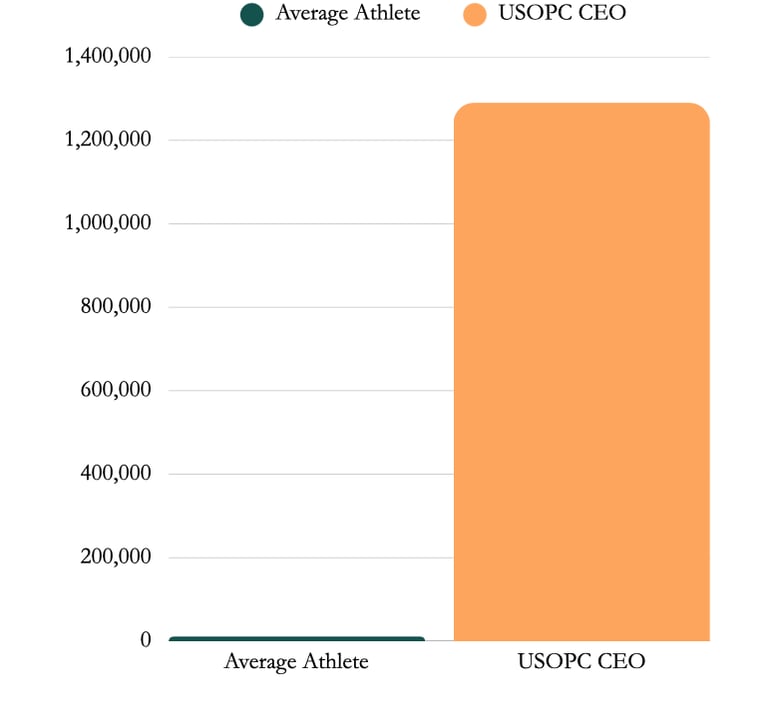
That’s $11,838 each. Less than $1,000 a month.
The CEO of the USOPC, Sarah Hirshland, made $1.29 million in 2024 — 109 times what the average distributed athlete received.
WHAT YOU’RE ACTUALLY GUARANTEED TO RECEIVE
Let’s be direct about what the system guarantees you as an athlete competing for Team USA:
If you win gold: $37,500 one-time bonus.
If you win silver: $22,500.
If you win bronze: $15,000.
If you don’t medal, which is the reality for the vast majority of Olympic athletes, you receive nothing from the Olympic Committee structure. Not a dollar.
Compare that to other countries:
Kazakhstan pays its gold medalists $250,000.
Singapore pays $737,000.
Hong Kong pays $769,000.
The United States, the country that wins the most medals and has the world’s largest economy at $30 trillion, pays its champions less than Kazakhstan, whose economy is 100 times smaller.
WHAT YOU CAN LEARN FROM THIS AS AN ATHLETE
The system doesn’t always work for you.
Executives at every layer of this pyramid have guaranteed salaries. You don’t. Some athletes are well compensated — most aren’t. But the one constant, at every level, is that the people running the organizations always get paid. Know which side of that equation you’re on.
Sports is a business. Learn how it works.
The IOC, the USOPC, your NGB — these aren’t just sporting bodies. They are businesses driven by revenue, contracts, and self-interest. The athletes who protect themselves financially are the ones who understand this. The ones who don’t are the ones choosing between training and rent.
Create your own freedom.
Don’t build a financial life that depends on a system that wasn’t designed to support you. Build investments. Start a business. Develop income that exists whether you medal or not. The goal isn’t just to compete at the highest level — it’s to still be standing when the competition is over.
Subscribe to our newsletter
Found this Valuable?
Every athlete deserves to understand the financial system they’re competing in.
Forward this to a teammate, a coach, or an athlete parent who needs to read it.